

· AFX Research
A Marital Home With an Unreleased UCC Fixture Filing in the Record
What a fixture filing claims against a marital home, where it sits in the county record, why stale ones outlive the debt, and what a divorce search can and cannot settle about it.
Table of Contents
A fixture filing is the encumbrance nobody in a divorce file is looking for. It is not a mortgage, it is not a judgment, and it does not show up in a payoff statement from the bank. It is a financing statement covering goods that were attached to the house after the house was built, and it gets recorded in the same books as the deeds — which means a parcel search can surface it and a casual look at the mortgage payoff never will.
What it actually claims
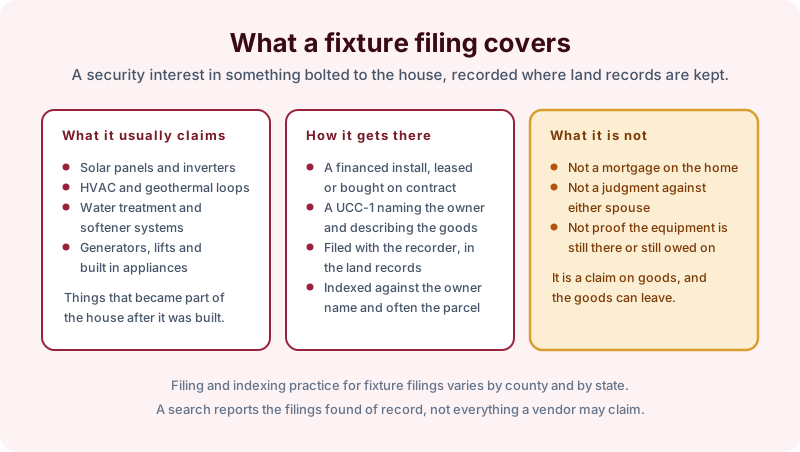
The usual subjects are solar arrays and inverters, HVAC and geothermal systems, water treatment equipment, standby generators, lifts and occasionally built-in appliances. Somebody financed the install, and the vendor or its funding partner filed to protect its interest in the goods once they were bolted to the structure.
That distinction is the whole point. The filing is a claim on the equipment, not on the real estate. It does not make the vendor a mortgagee and it does not give it a right to the house. What it does give it is a position that has to be dealt with before a buyer or a refinancing lender will accept the title, which is why it behaves like an encumbrance even though it is not one in the ordinary sense. Our note on solar panel leases and liens on the marital home covers the version of this problem that comes with its own lease agreement attached.
Where it sits, and for how long
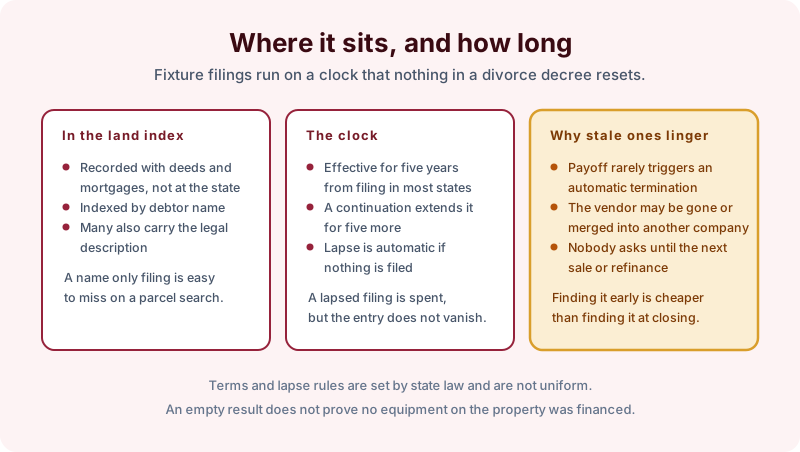
Unlike an ordinary UCC-1 against business assets, a fixture filing goes to the county recorder and lands in the land records beside the mortgages. It is indexed against the debtor’s name, and many counties also carry the legal description. A filing recorded under one spouse’s name alone, on a parcel held jointly, is exactly the kind of entry a name-only search can walk past.
It runs on a five-year clock in most states, extendable by a continuation, and it lapses automatically if nothing is filed. Lapse is not erasure. The entry stays in the index, and a search still reports it, because a report of what was found of record is the honest thing to hand an attorney who has to explain it to a client.
Stale filings outlive their debts for mundane reasons. Paying off a solar loan rarely triggers an automatic recorded termination. The vendor dissolves or gets absorbed into a company three names removed from the one on the filing. Nobody asks until someone tries to sell. If the house is heading for a sale of the marital home or a refinance into one name, that question arrives on a deadline.
What the search settles, and what it does not
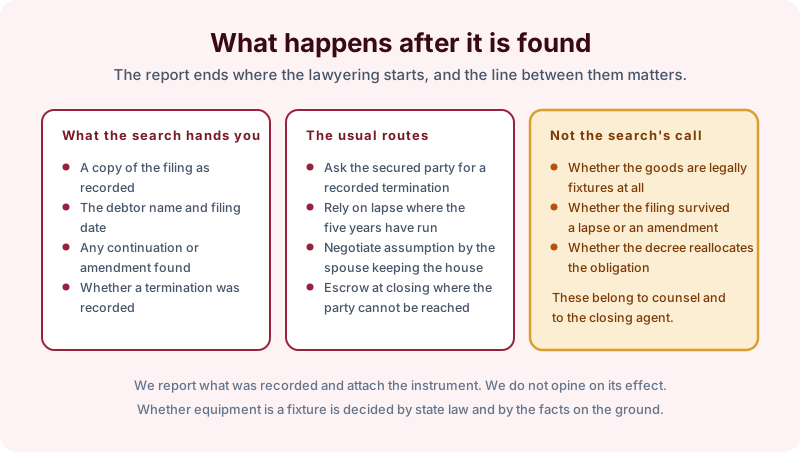
A search hands you the filing as recorded, the debtor name, the date, any continuation or amendment found, and whether a termination was ever recorded. That is the factual base, and it is what our search products are built to deliver. From there the routes are familiar. Request a recorded termination from the secured party, rely on lapse where the clock has genuinely run, fold assumption into the settlement for the spouse keeping the house, or escrow at closing when the filer cannot be found.
What a search cannot decide is whether the goods are legally fixtures at all, whether a particular filing survived an amendment, or whether the decree shifted the obligation between the parties. Those are legal conclusions, they turn on state law and on facts outside the record, and they belong to counsel. Recording and indexing practice for these filings varies county by county, so a clean result is evidence that nothing was found over the term searched, not proof that nothing on the property was ever financed.
The takeaway
Ask about installed equipment before the decree is drafted rather than after, because a fixture filing is cheap to clear six months out and expensive to clear the week of closing. Start the order online, or send us the names and the address and we will tell you what a search of that scope would and would not cover before anything is ordered.