

· AFX Research
Loan Modifications Recorded Against the Marital Home in a Divorce
Why the mortgage in the file is not always the mortgage on the house, what a recorded modification changes about the payoff, and why deferred principal surprises settlements.
Table of Contents
Plenty of marital homes carry a mortgage that has been rewritten at least once. A hardship after a job loss, a pandemic era workout, a rate reduction offered by the servicer — each of those can produce a loan modification, and a modification changes the terms of the existing loan without replacing it. The deed of trust in the closing file still describes the original deal. The payoff does not.
What a modification changes
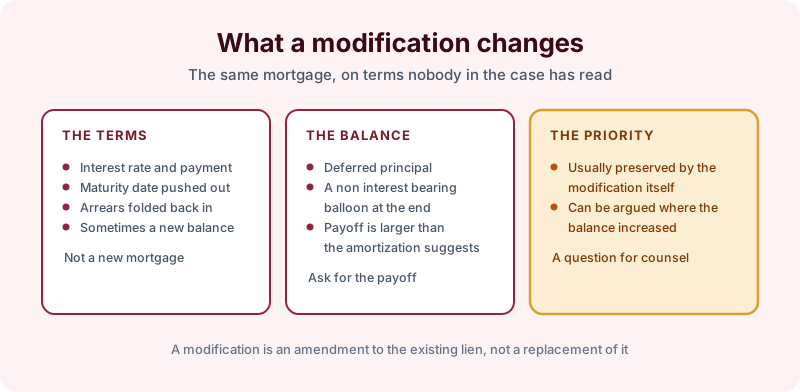
A modification is an amendment, not a refinance. The original mortgage or deed of trust stays in place and keeps its recording date. What changes is some combination of the rate, the payment, the maturity date and the principal balance.
The balance is where settlements go wrong. Arrears are frequently capitalized back into the loan, and in many workouts a slice of principal is deferred into a non interest bearing balloon due at payoff or maturity. That amount does not amortize, it does not show on a monthly statement in an obvious way, and it is real money owed at closing. A spouse who built a buyout around the amortization schedule can be tens of thousands of dollars out.
Where to look for one
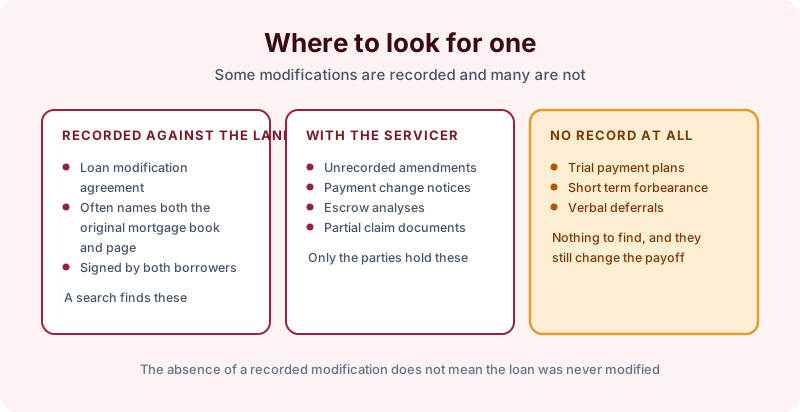
Some modifications are recorded and many are not. Where one is recorded, it is indexed against the property, usually names the book and page or instrument number of the mortgage it amends, and carries both borrowers’ signatures. A search of the parcel finds it.
Where the servicer never recorded the agreement — common when priority was not at risk and no new money was advanced — there is nothing in the land records to find. Trial payment plans and short term forbearance almost never generate a recorded instrument at all, which is the same gap described in a marital home with a mortgage in forbearance.
So the absence of a recorded modification is not evidence that the loan was never modified. It is evidence that nothing was recorded.
Who signed matters
A modification is signed by the borrowers, and in a divorce that detail does real work. If both spouses signed, both remain obligated regardless of what the decree later says about who keeps the house, because the lender is not a party to the decree. If only one signed, the other may still be on the original note while a stranger to the amended terms.
This is the practical heart of assuming the mortgage instead of refinancing. A modified loan is often harder to assume than an original one, and a release of liability is a decision the servicer makes rather than something a settlement can impose.
There is a records angle to it as well. Where a modification was recorded and only one spouse signed, the instrument itself is evidence of who was dealing with the lender during the period in question, which can matter in a case where the other spouse says they were never told. That is the kind of thing a copy of the recorded document settles and a recollection does not.
What a search can confirm
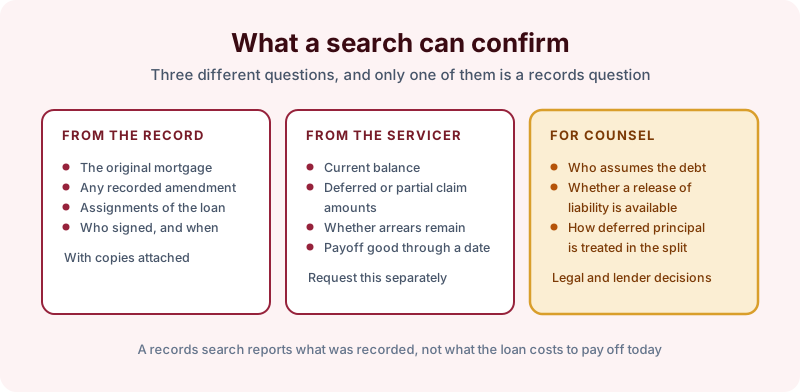
The search returns the mortgage, any recorded amendment to it, the assignments showing who holds it now, and the signatures on each. Those are facts of record, and they come back with copies attached.
The current balance is not a record question. Order a written payoff from the servicer, ask specifically whether any deferred or partial claim amount is outstanding, and read the good through date. Those two documents together — the recorded chain and the payoff — are what make a buyout number defensible.
It is worth running the search before the number is agreed rather than after. A second mortgage taken during the marriage, a judgment docketed against one spouse, or a tax lien recorded while the modification was being negotiated all sit in the same record and all come off the same proceeds, as home equity lines and second mortgages describes. Our process is built around returning those instruments with copies rather than a summary line.
The takeaway
A records search reports what has been recorded and indexed against the property in that county, and recording practice for modifications varies widely. It can show you that the loan was amended, when, and by whom it was signed. It cannot tell you what is owed today, and a clean parcel search does not prove the terms are the ones in the original note. Start the order online, or send us the names and the address and we will tell you what a search of that scope would and would not cover before anything is ordered.