

· AFX Research
Liens From a Prior Owner Still Attached to the Marital Home
Why a claim recorded against someone who owned the house years ago can still sit on the parcel, how it reaches a buyout number, and what the record can and cannot settle.
Table of Contents
Most liens found during a divorce property search were recorded against one of the spouses. Occasionally one was not. A judgment, a tax claim or a municipal charge recorded against an owner who sold the house long before your clients bought it can still be sitting in the index against that parcel, and it can change a buyout that both sides thought was settled.
How an old claim survives a sale
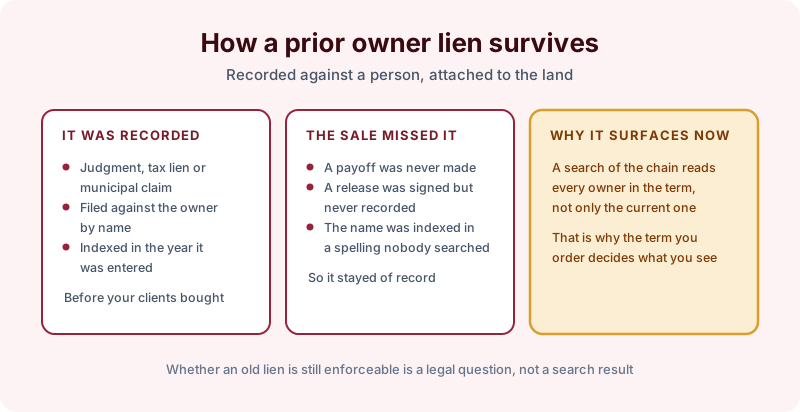
Liens are recorded against people, and they attach to the real property those people own in that county. The index entry is made under the debtor’s name in the year the claim was entered — it is not stamped onto the parcel the way a mortgage is.
That indexing is the whole explanation for how one survives. A closing that never ordered title work, a payoff made by check with no release ever recorded, or a name indexed in a spelling nobody thought to search can each leave a claim of record after the property has changed hands two or three times. It does not announce itself, and nothing in the current deed mentions it.
This is also why the term of the search matters so much. A current owner search looks at the present ownership and the open encumbrances. Reading back through earlier owners takes a longer search, which is the distinction drawn in marital versus separate property title searches.
What clears a claim, and what only looks like it did
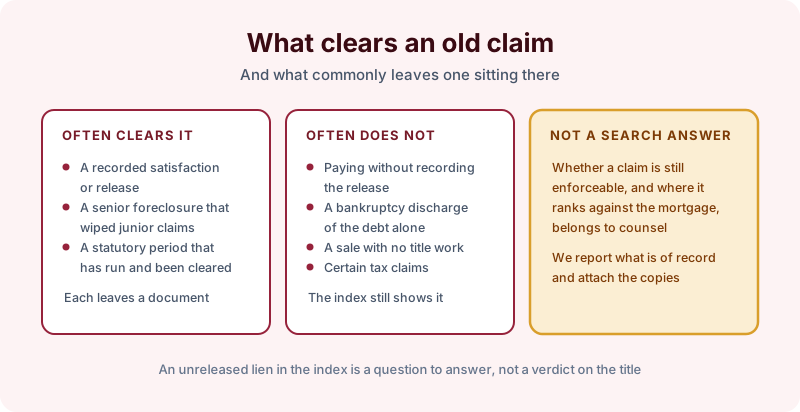
A recorded satisfaction or release is the clean case. A foreclosure by a senior lienholder commonly extinguishes junior claims, and the proceeding itself usually leaves recorded documents behind.
The cases that catch people out are the ones with no document. A debt paid in full but never released stays in the index exactly as it was. A bankruptcy discharge can relieve the debtor personally while leaving the lien on the property, and that interaction is covered in bankruptcy during a divorce title search. Some tax and governmental claims follow their own rules entirely.
What a search can tell you is that a claim appears of record and has no recorded release. Whether it is still enforceable, and where it would rank against the current mortgage, is a legal conclusion for counsel in that state — not something an abstractor determines.
Same name, different person
An old judgment indexed under a common name is not proof that it belongs to anybody in your case, or to the prior owner at all. Name indexes do not carry identifiers, so a report will list what matches and leave the identification open. The same problem runs in the other direction and is described in name variations and the property record.
Treat an unreleased entry as a question, not a finding. Confirming whether it belongs to the former owner usually means pulling the underlying case file.
What it does to the buyout
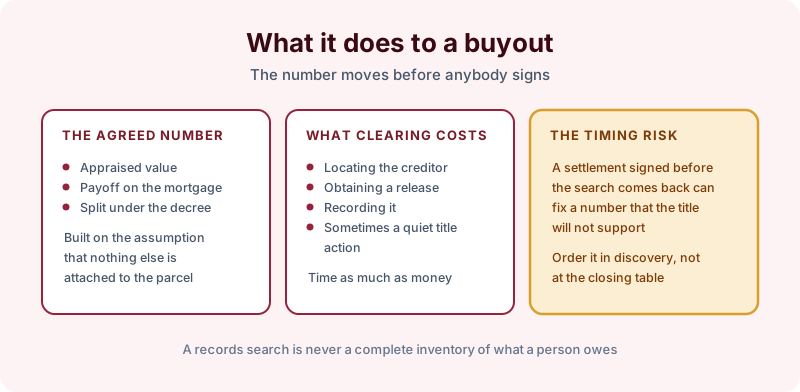
Equity splits are built on value minus the mortgage payoff. An unresolved claim of record sits outside that arithmetic until somebody tries to refinance or sell, and then it becomes a condition of closing.
Clearing one costs time more than money. Locating a creditor who may no longer exist, obtaining a release and getting it recorded can take weeks, and occasionally it takes a quiet title action. A settlement signed before the search comes back can fix a number the title will not support, which is the argument for ordering the search during discovery rather than at the closing table.
The takeaway
A records search reports what was recorded and found in the indexes reviewed, over the term searched, in the county where the property sits. It is not a complete inventory of what any person owes, an empty result does not prove a parcel is unencumbered, and recording and indexing practice varies by county. Start the order online, or send us the address and the names of every owner you know of and we will tell you what a search of that term would and would not cover before anything is ordered.