

· AFX Research
Eminent Domain and the Marital Home in a Divorce Title Search
What a road widening or a utility corridor does to the house you are dividing, where a taking shows up in the record, and what happens to the award once the land is gone.
Table of Contents
A condemnation does something unusual to a divorce. It converts the single largest asset in most settlements from a house into a sum of money, and it does so on a schedule nobody in the case controls. If a road widening, a transit corridor or a utility project is moving on the marital home, the question stops being who keeps the house and becomes who gets what, and when.
Three shapes a taking can have
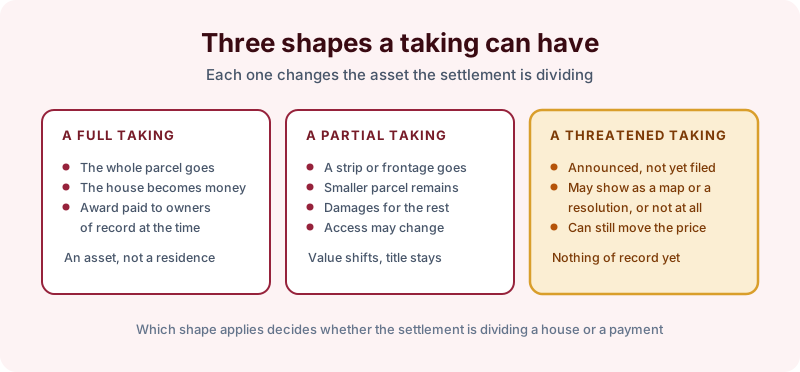
A full taking removes the entire parcel. The house is gone, the award replaces it, and the settlement is dividing cash rather than real estate.
A partial taking is more common and more awkward. An agency takes a strip for widening or a permanent easement for a line, leaving a smaller parcel and a payment for the part taken plus damages to what remains. Title stays with the owners, but the property is not the property either spouse agreed to divide.
A threatened taking is the one that catches people out. A project may be announced, budgeted and designed for years before anything is filed, and during that window it can move the market value of the home substantially without leaving a single recorded instrument.
Note that this is a different situation from the one in a damaged or condemned marital home, where “condemned” means a building declared unsafe. Same word, unrelated problem.
Where a taking shows up
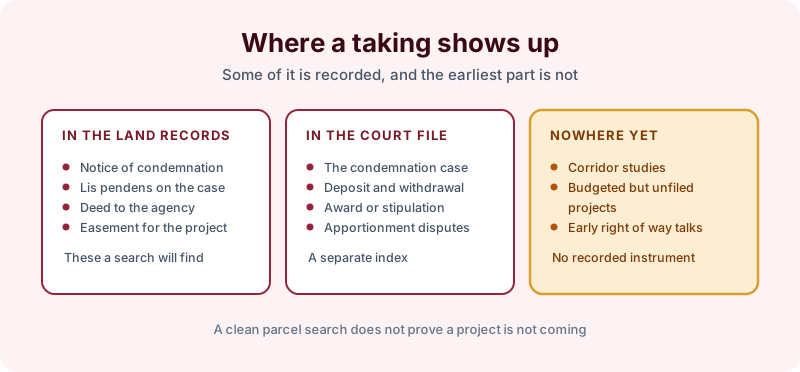
Once an agency acts, the land records usually carry something, whether that is a notice of condemnation, a lis pendens tying the parcel to a case, a deed to the agency where the owner settled, or a recorded easement for the project. A search of the parcel reports what was recorded and found, and these are the instruments it finds.
The condemnation case itself sits in a court index rather than the land records, and in many counties those are two different systems with two different search routines. The deposit, the withdrawal and the final award typically live there.
The planning stage lives nowhere a records search can reach. A clean parcel search tells you nothing about a corridor study, and it is not evidence that a project is not coming. The agency’s own right of way office, the county or city capital plan, and the project website are the places that answer that question, and they answer it better than any index will.
Recording practice varies, too. Some jurisdictions record a map of definite location or a project resolution against every affected parcel, and others record nothing until the deed or the final judgment. Do not read one county’s habit as a national rule.
What the award becomes
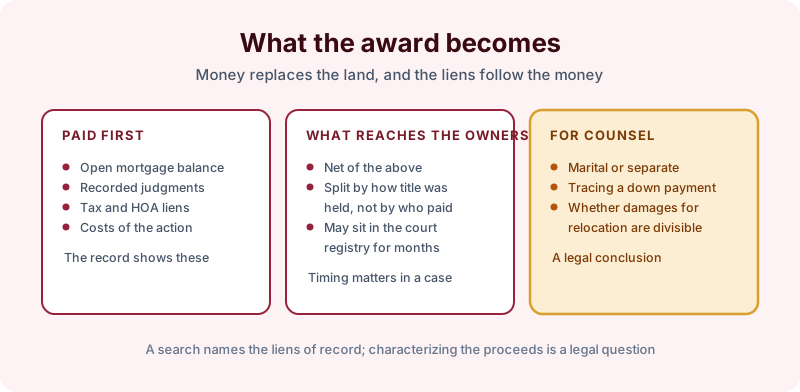
Money takes the place of the land, and the liens follow the money. The mortgage is paid from the award, and so are recorded judgments, tax liens and association liens, which is the ordinary priority pattern described in liens against marital property. What reaches the owners is the net, divided according to how title was held rather than according to who made the payments.
Two things slow this down in practice. Awards frequently sit in a court registry pending apportionment, sometimes for a long time. And where a lien of record is stale or was never released, it has to be cleared before anything is disbursed, which is the problem unreleased old mortgages describes.
Whether the proceeds are marital or separate, and how damages for relocation or lost business are treated, are legal conclusions for counsel in that state. A search does not reach them. The same is true of a buyout structured around a parcel that is about to shrink, where the number both sides agreed on was a number for the whole property, as securing a divorce buyout sets out.
The takeaway
A records search reports what has been recorded and indexed against the parcel in that county over the term searched. It can show a notice, a lis pendens, an agency deed or a project easement, and it can show every lien that will be paid before either spouse sees a dollar. It is not an inventory of what an agency is planning, and an empty result does not prove a taking is not in motion. Start the order online, or send us the address and the county and we will tell you what a search of that scope would and would not cover before anything is ordered.