

· AFX Research
Cemetery Plots and Burial Rights in a Divorce Settlement
Burial spaces bought during a marriage are property, and almost none of it sits in the county record. Where the paperwork lives, and how settlements handle it.
Table of Contents
Couples buy burial spaces together, usually several at once, usually decades before anyone expects to need them. Then the marriage ends and nobody knows what to do with four spaces in a family section. It is a small item that produces a disproportionate amount of friction, partly because it is emotional and partly because the usual tools do not work. A property search does not find it, for a reason worth understanding before anyone goes looking. The gap is similar in shape to timeshares and vacation property in a divorce search, where the thing being divided is not quite real estate.
What a plot actually is
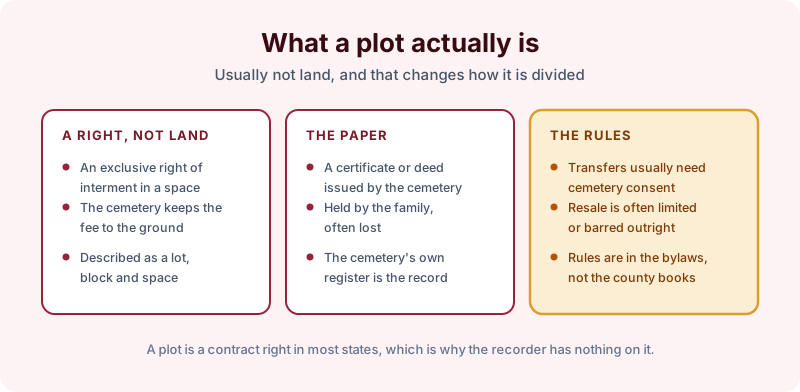
In most states, buying a plot does not buy land. It buys an exclusive right of interment in a described space, while the cemetery keeps the underlying fee. The space is identified by section, lot, block, and number rather than by a legal description a surveyor would recognize.
What the family holds is a certificate or a deed of interment issued by the cemetery, and those are lost about as often as they are kept. The authoritative record is the cemetery’s own register.
The rules attached to it do most of the work. Transfers typically require the cemetery’s consent, and resale to a third party is restricted or prohibited outright in many places, with the cemetery reserving a right of first refusal at the original price. Those terms sit in the cemetery’s bylaws and in the purchase contract, not in anything a county keeps.
Where the record actually sits
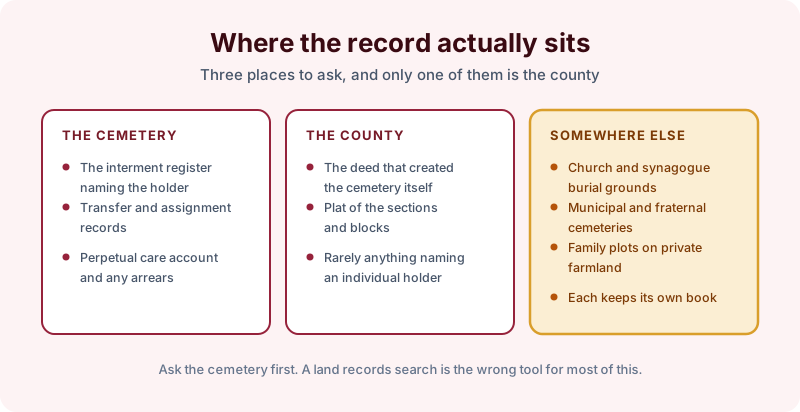
The cemetery association holds the interment register naming the current holder, the transfer and assignment records, and the perpetual care account with any arrears on it. That is where the answer is.
The county usually holds only the deed that created the cemetery and a plat of its sections. It very rarely holds anything naming an individual plot holder, which is why a name search for a spouse returns nothing even where several spaces were bought in their name.
And a great many burial grounds sit outside that structure entirely. Church and synagogue cemeteries, municipal and fraternal ones, and family plots on farmland each keep their own books under their own rules. Family plots on private land are the exception that touches the land record, since a reserved burial ground can appear as a restriction in the deed, which is the sort of finding our note on easements and access on divided marital property deals with.
How settlements usually handle it
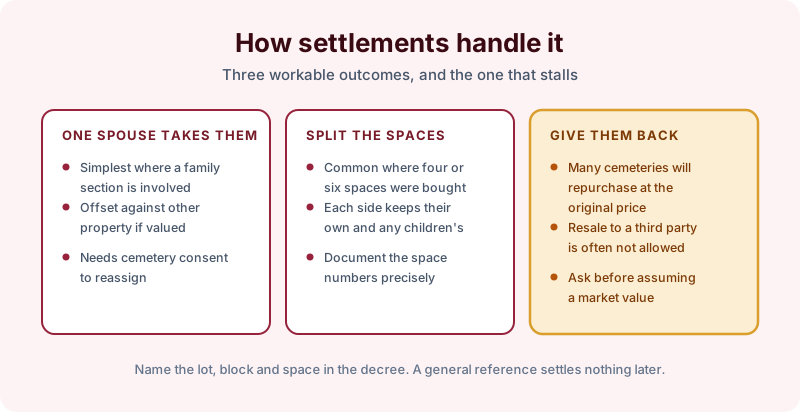
Three outcomes cover most cases. One spouse takes the spaces, which is simplest where they adjoin a family section, with an offset elsewhere if anyone bothers to value them. Or the spaces are split, which suits the common purchase of four or six, with each side keeping their own and any set aside for children. Or they go back, because many cemeteries will repurchase at the original price and that is frequently the cleanest exit when neither party wants them.
Whichever applies, the decree needs to name the cemetery and the exact section, lot, block, and space numbers. A settlement that refers to the burial plots in general terms settles nothing, and the disagreement surfaces years later at the worst possible moment.
Our abstractors report what was recorded and found in the land records over the term searched, and on this item the land records are usually silent. That is a real limit rather than a thin search, and the cemetery office is the place to direct the request. Our process is built to say plainly which offices were read and what they held.
The takeaway
Treat burial spaces as a contract right held with the cemetery rather than as real estate. Write to the cemetery for the register entry and the transfer rules, decide early whether to split, allocate, or sell back, and put the exact space numbers in the decree. Start the order online, or send us the names and addresses and we will tell you what a search of that scope would and would not cover before anything is ordered.