

· AFX Research
Private and Family Mortgages Recorded on the Marital Home
A loan from a parent or a friend may be secured by a recorded instrument, or by nothing at all, and the difference decides what a property search is able to find.
Table of Contents
A surprising share of marital homes carry money that never came from a bank. A parent helps with the down payment, a sibling funds the kitchen, a family friend bridges a gap between two closings. Sometimes that money was secured by a mortgage or deed of trust and recorded like any other lien. Sometimes it rests on a note in a drawer. The difference decides what a title search can tell you, and it is worth establishing early rather than at the buyout.
Recorded, or not recorded at all
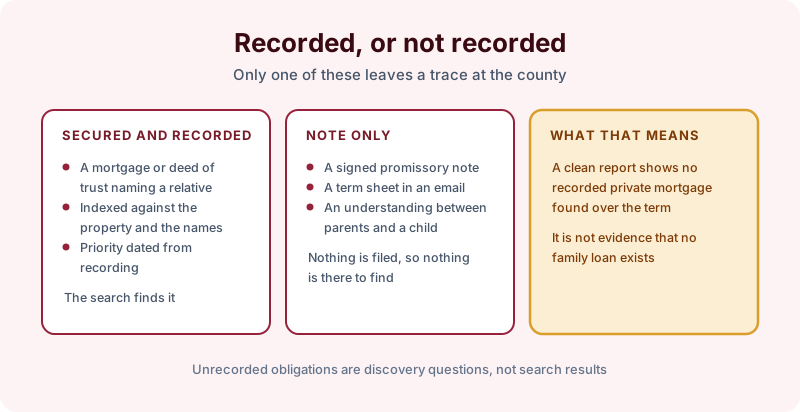
A private loan that was properly secured looks much like an institutional one in the index. There is a mortgage or a deed of trust, the lender is an individual or a family trust rather than a bank, and it is indexed against the property and against the names. A search over the right term finds it and attaches a copy.
A loan that was never secured leaves nothing behind. There is no filing to index, so there is nothing for an abstractor to retrieve. This is the point where a clean report is easiest to misread. It means no recorded private mortgage was found over the term searched, and it is not evidence that no family loan exists — unrecorded obligations are a discovery question, pursued through bank records and testimony, not through the recorder. The same limit runs through unrecorded deeds and side agreements in a divorce.
Reading the entry when there is one
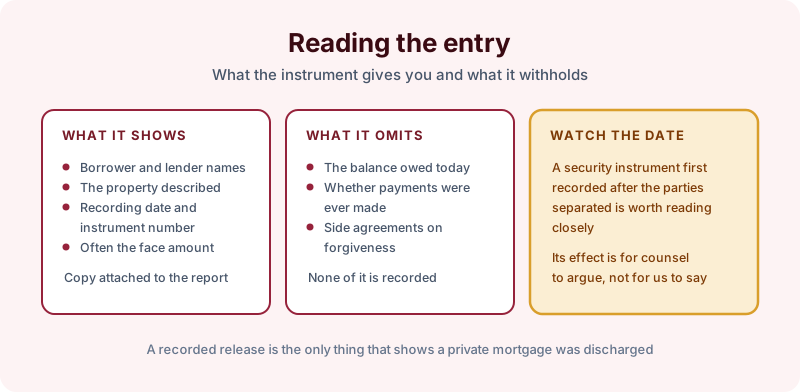
The instrument gives you the parties, the property, the recording date and instrument number, and usually a face amount. It does not give you the balance owed today, whether a single payment was ever made, or whether the lender told the borrower years ago to forget about it. None of that is recorded.
The recording date repays attention. An instrument first recorded after the parties separated, or shortly before a petition was filed, is worth reading closely alongside the deed history. What effect it has is an argument for counsel, and the related timing question is set out in deeds recorded during a separation.
One more point on the record side. The only thing that shows a private mortgage has been discharged is a recorded release or satisfaction. Family lenders frequently never record one even after they have been paid, so an open entry does not establish that the money is still owed.
When the private lender has died or disappeared
A bank is still there in ten years. A family lender may not be. If the person who took back the mortgage has died, the right to release it passes to their estate or their heirs, and obtaining a recordable release can mean opening a probate file or tracking down several siblings who have never discussed it.
That turns a line item into a timetable. Where a refinance or a sale is going to be the mechanism for one spouse to keep the house, this is the kind of encumbrance that should be identified in discovery, because the party who has to clear it will need months rather than days.
Where it lands in the split
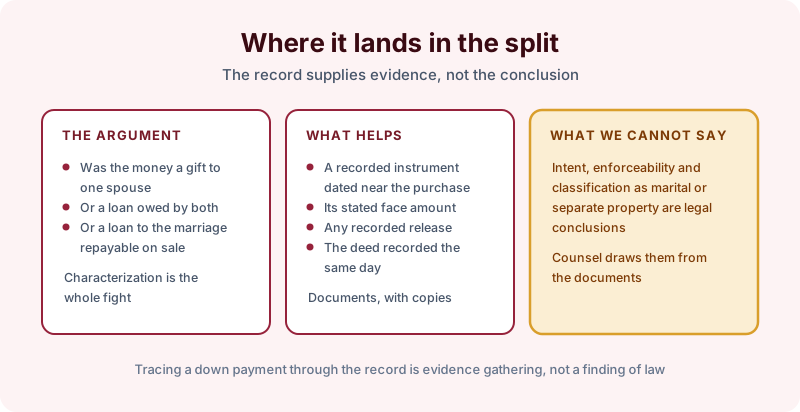
The contested question is almost always characterization. Was the money a gift to one spouse, a loan owed by both, or an advance repayable when the house sells? That determines whether it reduces the equity being divided and whose share it reduces.
The record supplies evidence rather than the answer. A security instrument recorded the same day as the deed, for an amount that matches the down payment, is a useful document to put in front of a judge, and that is the evidentiary work described in tracing a down payment in the property record. Intent and classification remain legal conclusions drawn by counsel.
The takeaway
A records search reports what was recorded and found in the indexes reviewed, over the term searched, in the county where the property sits. It cannot see an unrecorded loan, it cannot tell you a recorded one has been repaid without a recorded release, and recording and indexing practice varies by county. Start the order online, or send us the address and the names on both sides of the family and we will tell you what a search of that scope would and would not cover before anything is ordered.