

· AFX Research
Foreign Property in a Divorce and What No Search Reaches
A US records search ends at the border, and most countries do not run county indexes. What still shows up at home, and how to scope the question honestly.
Table of Contents
One spouse believes the other owns an apartment overseas. A nationwide search of US records comes back with nothing, and the obvious conclusion is wrong, because a county index in this country has no reason to know about land anywhere else. That is a real limit rather than a thin search, and it is worth setting out plainly before anyone spends money on the wrong thing. The shape of the problem resembles out of state property in a divorce, with the difficulty raised considerably.
Where a US search stops
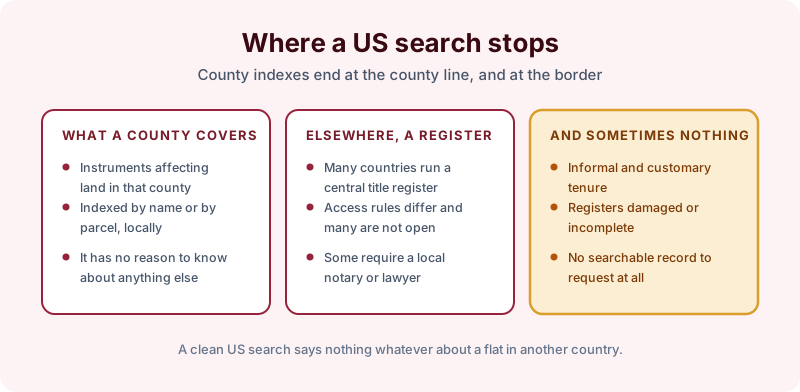
An American county index covers instruments affecting land in that county, organized by name or by parcel. That is its whole job. Running more counties widens the net within the United States and does nothing at all about anywhere else.
Many other countries work differently again. A central title register is common, often more authoritative than anything here, but access rules vary enormously. Some are open to anybody, some only to the owner or to a lawyer or notary acting locally, and some require a reason to be given before they will answer.
And in parts of the world there is effectively nothing to search. Informal or customary tenure, registers damaged or never completed, and systems where possession rather than paper is the evidence. A search request there is not slow, it is unanswerable, and a report that implied otherwise would be worse than no report.
What the US record still shows
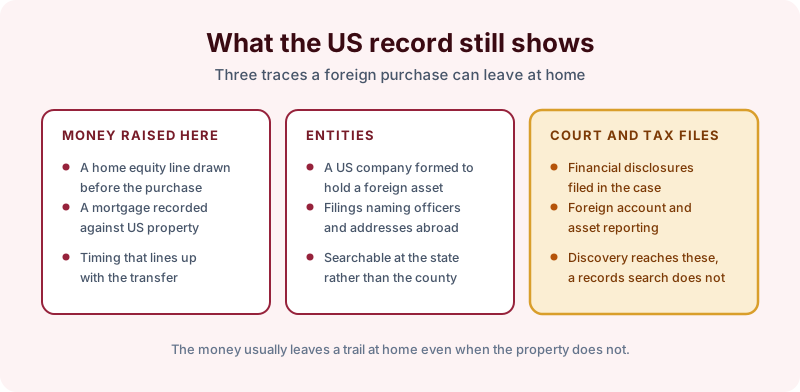
The money usually leaves a trail at home even when the property does not. A home equity line drawn months before a purchase abroad, or a mortgage recorded against a US property whose proceeds went somewhere, both sit in the land records with dates attached. Timing is the useful part. A line of credit drawn for an amount nobody can account for, three months before a spouse started spending time in another country, is the kind of fact a settlement conversation can be built on even without the deed.
Entities are the second trace. A limited liability company formed in one state to hold an asset in another country files with that state rather than with any county, and those filings name officers and addresses. That is a separate search from the land records and frequently the more productive one, in the way described in property in an LLC or trust.
The third category is not records work at all. Financial disclosures filed in the case and foreign asset reporting obligations are reached through discovery, and counsel is the one who reaches them. A property search can tell counsel where to point, and narrowing the question is most of what records work contributes here.
How to scope it honestly
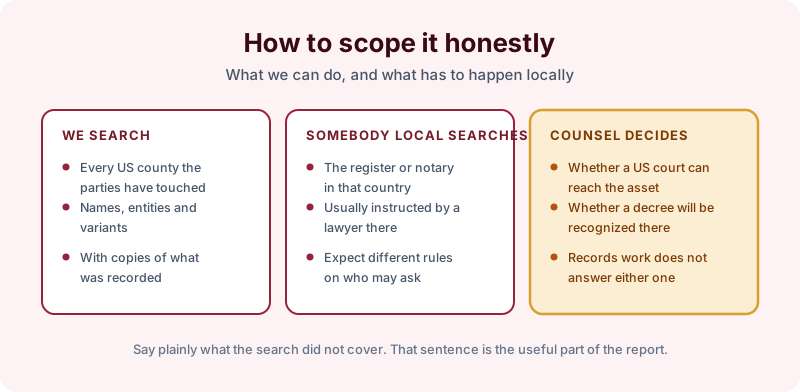
We can search every US county the parties have touched, under every name and entity variant, and return copies of what was recorded. That is worth doing, because US traces of a foreign purchase are common and are often the only thing anyone can actually obtain.
The property abroad needs somebody local. A register search or a notary enquiry in that country, usually instructed through a lawyer there, under whatever rules apply to who may ask.
And the questions that sit above both are legal. Whether a US court can reach the asset, whether a decree will be recognized where the property sits, and what happens if it is not are matters for counsel. Our abstractors report what was recorded and found in the offices searched, and a search is never a complete inventory of a person’s holdings. Our process is built to say plainly which offices were read, and on this question what the report does not cover is the most important line in it.
The takeaway
Treat a foreign asset as outside the search rather than as something the search failed to find. Run the US records hard for the financing and entity traces, instruct somebody local for the register itself, and put the jurisdiction question to counsel early. Start the order online, or send us the names and addresses and we will tell you what a search of that scope would and would not cover before anything is ordered.