

· AFX Research
A Marital Home in a Flood Zone, and What the Record Shows
Flood maps, recorded drainage easements, buyout and elevation covenants, stormwater assessments, and what a title search can confirm about a marital home that sits in a flood zone.
Table of Contents
A flood zone is not a title problem, but it leaves title problems behind it. The designation itself comes from a FEMA map rather than from the county land records, so a title search will not tell you what zone a marital home sits in. What a search can tell you is whether past flooding, past repairs, or past public works left something recorded against the property, which is exactly the sort of thing that changes the arithmetic in a settlement.
Three different custodians
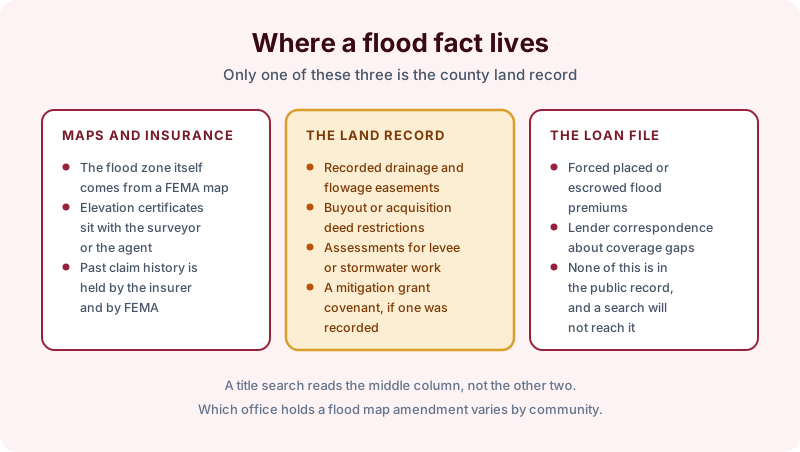
The flood zone, the elevation certificate, and the claim history live with FEMA, the surveyor, and the insurer. The premium and any forced-placed coverage live in the loan file. Neither set is public record, and neither is reachable by a records search.
The land records hold a narrower but important set of facts, and those are the ones that travel with the deed to whoever keeps the house.
What flood work leaves in the record
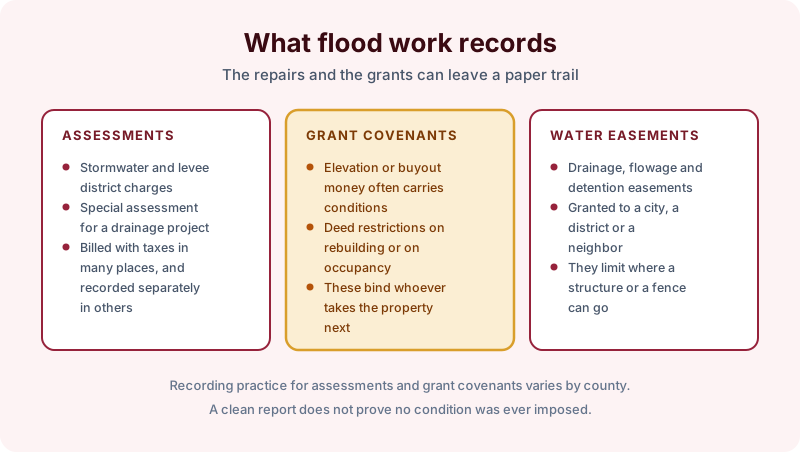
Assessments are the most common. Stormwater utilities, levee districts, and special assessments for a drainage project all attach to the parcel. In some counties they are billed with the taxes and never appear as a separate recorded instrument; in others the district records a notice. Which it is varies locally, so the absence of a recorded assessment is not proof that none is being charged.
Grant covenants are the most consequential. Federal and state money for elevating a house, acquiring a repetitive-loss property, or floodproofing a structure frequently comes with conditions, and those conditions are often recorded as deed restrictions. They can bar rebuilding, limit occupancy, or require that the lot stay open. A spouse who keeps the house keeps the restriction too.
Water easements are the easiest to miss. Drainage, flowage, and detention easements granted to a city, a district, or a neighbor limit where a structure, a fence, or a pool can go. They show in a search when they were recorded, and they are a frequent surprise on older subdivisions.
Why this matters to the settlement number
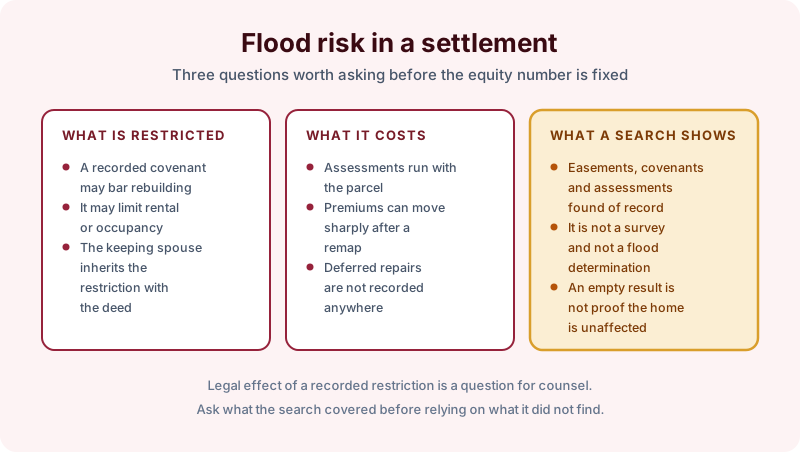
Equity in a flood-exposed home is harder to pin down than equity in a dry one. Premiums can move sharply after a community is remapped, assessments run with the parcel regardless of who signed for them, and deferred repairs are recorded nowhere at all. A buyout covenant can make the lot worth less than the appraisal assumed, or in some programs can make it unsellable for its current use.
None of that is a legal conclusion the abstractor can draw. What the search does is put the recorded instruments in front of counsel, who can then read what the covenant actually requires. If the plan is for one spouse to refinance in their own name, the recorded restrictions are usually the first thing the new lender asks about, so pulling them during the search rather than during underwriting saves a cycle.
What the search reports, and what it does not
The report sets out who holds record title, every mortgage, judgment, lien, assessment, easement, and recorded restriction found of record against the property over the term searched, and the instruments themselves. It is not a survey, it does not locate a flood line or an easement on the ground, and it is not a flood determination. Recording practice varies by county. An empty result is not proof that a home is unaffected, only that nothing was found of record in the offices searched.
A pace assessment recorded for flood retrofit work is a good example of the overlap, and a damaged or condemned home is the version of this problem after the water has already come in.
The takeaway
Ask for the recorded instruments rather than the flood zone. The zone comes from a map that anyone can look up, while the covenant, the easement, and the assessment are the facts that bind whoever ends up with the deed, and those only come out of the land records.
Start the order online, or send us the names and addresses and we will tell you what a search of that scope would and would not cover before anything is ordered.