

· AFX Research
What a Land Trust Hides in a Divorce Property Record Search
A land trust puts a trustee on the deed and keeps the real owner private. What the record still shows, and where the rest of the answer has to come from.
Table of Contents
A spouse runs a name search, finds nothing, and concludes there is no other real estate. In a handful of states that conclusion is unsafe, because a land trust is designed to produce exactly that result. The deed names a trustee and a trust number, the person who actually benefits is nowhere in the public record, and a search run on their name comes back clean. It is a more deliberate version of the problem described in finding undisclosed real estate in a divorce.
What the deed shows, and what it withholds
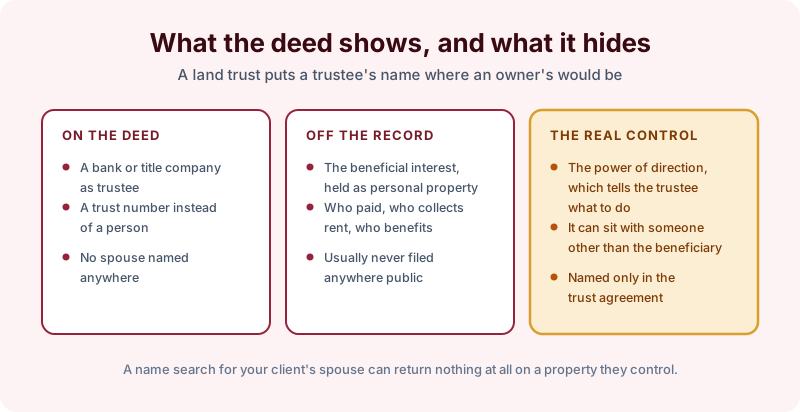
On the face of the record you see a bank, a title company, or an individual holding as trustee under a trust agreement, usually identified by a number and a date. That is the whole of it. No beneficiary, no spouse, nothing linking the property to a person a name search would turn up.
The beneficial interest is held off the record and is treated in these states as personal property rather than as an interest in land. That characterization is not a technicality in a divorce. It affects how the interest is classified, how it can be transferred, and how a creditor or a former spouse can reach it.
The item worth naming separately is the power of direction. The trustee acts only when directed, and the person holding that power can be someone other than the beneficiary. So the question is not only who benefits but who tells the trustee what to do, and that is named in the trust agreement rather than anywhere a recorder would keep it.
How it still surfaces
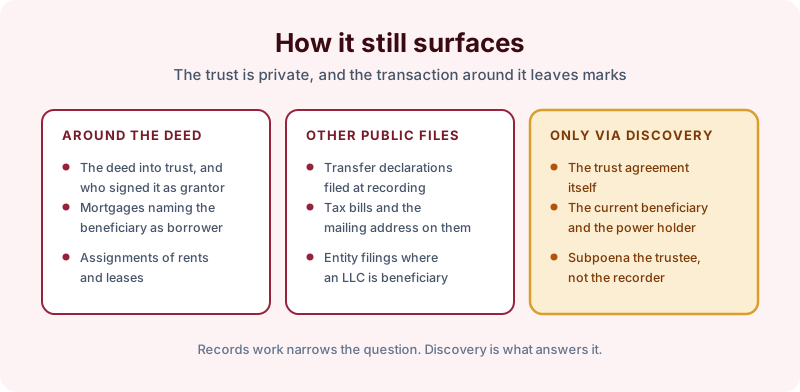
The trust is private. The transactions around it are not, and that is where a search earns its keep.
Look at the deed into trust and read who signed as grantor, because a spouse conveying their own house into trust appears there by name. Look at mortgages and assignments of rents, since a lender will often require the beneficiary to sign, and at any recorded lease. Transfer declarations filed at recording, tax bills and the address they are mailed to, and entity filings where the beneficiary is an LLC all add names the land records alone do not.
What none of that produces is the trust agreement. Getting that means a subpoena to the trustee, which puts it alongside the other material covered in title search in divorce discovery. Records work narrows the question and tells counsel precisely what to ask for.
What a search can and cannot settle
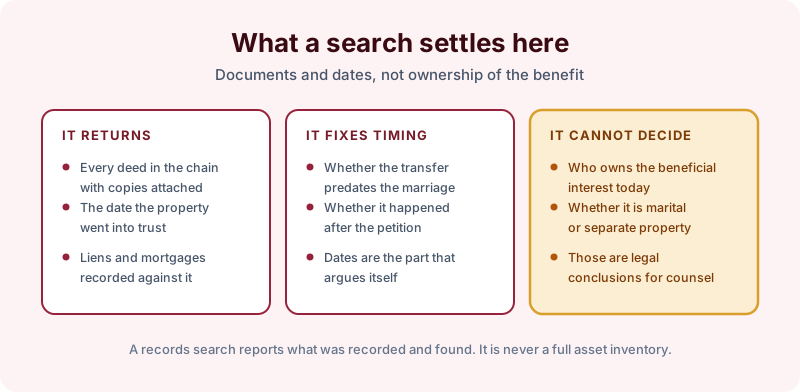
A search over the parcel returns every deed in the chain with copies attached, the date the property went into trust, and the liens and mortgages recorded against it. Our search products are built around how far back that chain needs to run.
Timing is often the most useful output. Whether the conveyance into trust predates the marriage, happened during it, or landed after the petition was filed is a fact the record fixes with a date stamp, and it is the part of the picture that tends to argue itself.
What a search cannot do is decide who owns the beneficial interest today or whether it is marital or separate property. Those are legal conclusions for counsel. Our abstractors report what was recorded and found over the term searched, a search is never a complete inventory of a person’s holdings, and recording and indexing practice varies by county, so an empty result is not proof that nothing exists.
The takeaway
Treat a clean name search as a starting point rather than an answer when land trusts are used in that state. Search the property as well as the people, read who signed the deed into trust, collect the recorded instruments that name a beneficiary, and let counsel take the trust agreement through discovery. Start the order online, or send us the names and addresses and we will tell you what a search of that scope would and would not cover before anything is ordered.